 Image 1 of 1
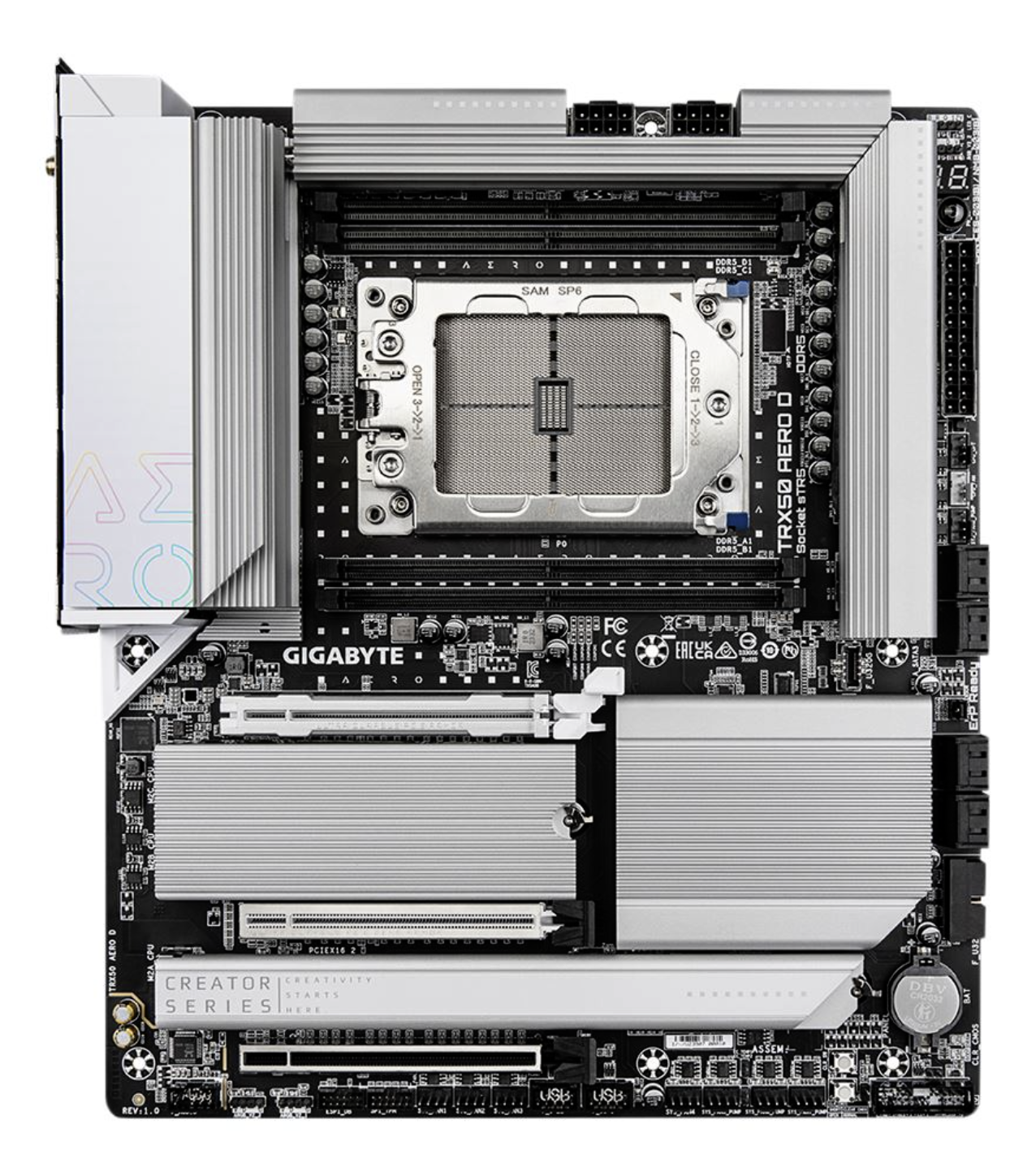
The Gigabyte TRX50 AERO D is a high‑end workstation / prosumer motherboard designed for AMD’s sTR5 socket (Threadripper PRO / Threadripper 7000 series) and built around the TRX50 chipset, aimed at content creators, AI workloads, and heavy multitasking environments. With a 16+8+4‑phase digital VRM power delivery, reinforced by an enlarged heat pipe and VRM armor, it provides strong and stable power for demanding CPUs. Memory support is quad‑channel DDR5 with four RDIMM slots, up to 1 TB capacity, with support for overclocked memory speeds (up to ~ 7800 MT/s OC) and official support for EXPO/XMP profiles. For storage and expandability, it includes four M.2 slots (three Gen5, one Gen4), eight SATA ports, and three full‑length PCIe x16 slots (two Gen5, one Gen4) for GPU / accelerator / PCIe device setups. Connectivity is also modern: dual USB4 Type‑C ports, dual LAN (10 GbE + 2.5 GbE), built‑in WiFi 7 with a high‑gain antenna, plus strong audio (Realtek ALC4080 + ALC897) and good onboard headers. On the flip side, its large E‑ATX footprint means case space must be checked; early user reports suggest that memory compatibility / training (especially with high‑speed or dual‑rank RDIMMs) can require patience (BIOS tuning, clearing CMOS, proper DIMM placement), and cost / power draw are on the high side, as with any platform this capable.
The Gigabyte TRX50 AERO D is a high‑end workstation / prosumer motherboard designed for AMD’s sTR5 socket (Threadripper PRO / Threadripper 7000 series) and built around the TRX50 chipset, aimed at content creators, AI workloads, and heavy multitasking environments. With a 16+8+4‑phase digital VRM power delivery, reinforced by an enlarged heat pipe and VRM armor, it provides strong and stable power for demanding CPUs. Memory support is quad‑channel DDR5 with four RDIMM slots, up to 1 TB capacity, with support for overclocked memory speeds (up to ~ 7800 MT/s OC) and official support for EXPO/XMP profiles. For storage and expandability, it includes four M.2 slots (three Gen5, one Gen4), eight SATA ports, and three full‑length PCIe x16 slots (two Gen5, one Gen4) for GPU / accelerator / PCIe device setups. Connectivity is also modern: dual USB4 Type‑C ports, dual LAN (10 GbE + 2.5 GbE), built‑in WiFi 7 with a high‑gain antenna, plus strong audio (Realtek ALC4080 + ALC897) and good onboard headers. On the flip side, its large E‑ATX footprint means case space must be checked; early user reports suggest that memory compatibility / training (especially with high‑speed or dual‑rank RDIMMs) can require patience (BIOS tuning, clearing CMOS, proper DIMM placement), and cost / power draw are on the high side, as with any platform this capable.